Wharton Esherick Home And Studio Is One Of Malvern’s Hidden Gems
by Melissa Jacobs
When Wharton Esherick – woodworker, sculptor, and furniture maker – broke ground on his studio in 1926, he also broke ground on what would be become his long-lasting legacy in American craft and furniture. Of course, he didn’t know that at the time. Back then, Wharton Esherick was just beginning to carve his niche in the art world.
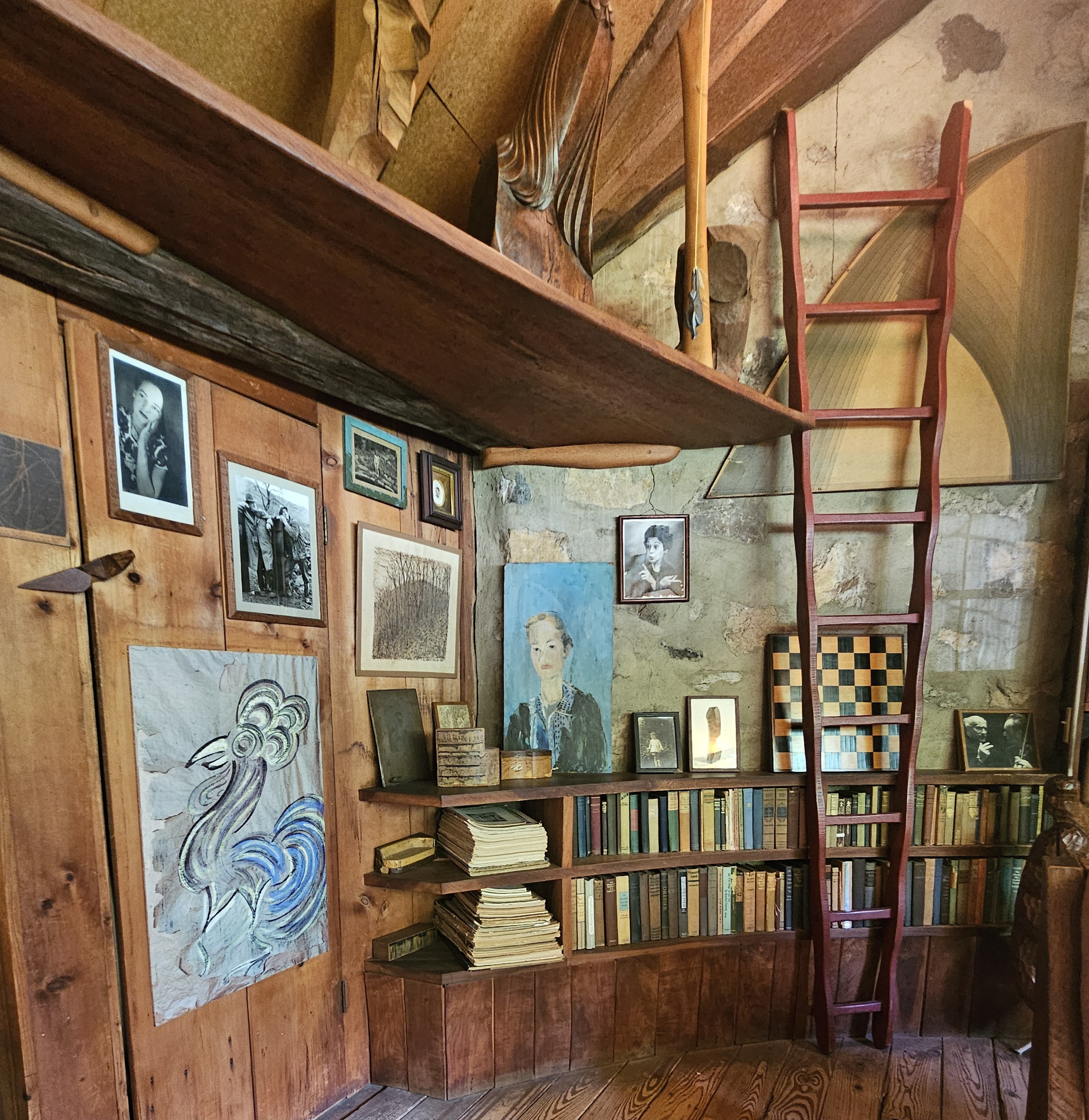
Now, 100 years later, that Malvern mountain home and studio is a National Historic Landmark for Architecture that honors Esherick’s work in all of its mediums. From the winding staircase to the sculpture of intertwined lovers to the delightfully wacky kitchen, Esherick’s house is filled with wonder.
“The entire place – house, studio, grounds – is a work of art,” explained Katie Wynne, deputy director of operations and public engagement. “Here, we see Esherick’s pieces in situ, which is a different experience than seeing them in a traditional museum setting.”
Very little is traditional about Esherick’s home. There is so much wood and natural light, so many clever nooks and deliberate delights, that it feels like being in a treehouse built by an eccentric idealist with unquestionable skill and a clear point of view, garnished with winks of whimsy. Perhaps it is the Chester County version of Gaudi’s Casa Batlló, a house so artistically unique that it could only have been created by one person.
Exploring Esherick’s space is intriguing, not invasive. This is not a pristine shrine to an artist, although it has been carefully curated by those tasked to do so. Still, it feels so authentic that you almost expect to see empty glasses stained with red wine and vinyl records not yet resleeved, and smell cigarette smoke, mingling with wood dust, linseed oil and, most likely, perfume.
Docents are more than capable of explaining Esherick’s personal life, and people do tend to be curious about such things. But the docents are far more useful for showing the hidden bits of Esherick’s furniture. Levers here and pulleys there show the interiors of his desks and bureaus. Even Esherick’s otherwise spartan bed has a hidden compartment for his clothes, which are still there, neatly folded.
Peeking, but not prying, into Esherick’s inner world is a great way to gain an understanding of the man who, to fans of the Studio Furniture Movement, remains an icon. In his own time and now, more than 55 years after his death, Esherick is considered an unconventionally creative, genre-defying and groundbreaking.
Indeed, Breaking Ground is the name of the 32nd Annual Juried Woodworking Exhibition now on view at the museum and online. The exhibition includes 26 pieces created by artists from all over the country. “We wanted to commemorate the 100th anniversary of the studio’s completion by inviting today’s artists to create pieces that speak to what they consider groundbreaking,” Wynne said.


Of course, the largest work of art is the house itself. Nestled into its mountain, the house is a magical jewel box filled with hundreds of Esherick’s wood sculptures, furniture and paintings. Those pieces had been cared for and displayed at the 12-acre estate for decades, until 2024, when the Wharton Esherick Museum and Brandywine Museum launched The Crafted World of Wharton Esherick, an exhibit that, for the first time, brought Esherick’s art and furniture to audiences in Chadds Ford and other cities.
“That was great exposure for Wharton Esherick and our museum,” Wynne said, “because although we know all about him, many people are still unfamiliar with his work.” If the exhibit generated new interest in Esherick, it also created change at his estate.

While preparing The Crafted World of Wharton Esherick, curators at Wharton Esherick Museum dove into their archival storage to find pieces to replace those being lent out for the year-long exhibit. Wynne and her colleagues decided to put those pieces on display and show visitors what had been squirreled away for many years.
Some of the heretofore hidden pieces are furniture and some are more basic but no less fascinating, like the 1950s Blaupunkt radio and the wooden swing arm that Esherick built to move the rather cumbersome radio from the kitchen table to its adjacent outdoor deck. “We reinstalled the swing arm and radio and knew exactly where it went because there are holes in the door for it,” Wynne said.

Discoveries like those make the Wharton Esherick Museum an ongoing adventure for visitors. There are always delightful new details to explore. “This is a living, changing space,” Wynne said. “You don’t have to know furniture or be an academic to appreciate Esherick’s work. You don’t need to know the ‘-isms.’ You just need to have an open mind.”
Wharton Esherick Museum is open for tours March – December. Reservations are required. The entry level tour is a little over one hour and the separate topic tours are a great way to dive deeper into Wharton Esherick’s life and work.
For more information, visit Wharton Esherick Museum’s website.
Connect with Main Line Tonight!
Join the in crowd! Get our stories delivered to your inbox.
Top Stories
-

A Powerful Conversation With HEADStrong President Cheryl Colleluori by Melissa Jacobs For Cheryl Colleluori, celebrating HEADStrong Foundation’s anniversary is a mixed bag. The foundation’s accomplishments are clear: The Colleluori family grew HEADStrong into a national nonprofit that has raised more than $39 million and supported almost 40,000 families whose loved ones are seeking treatment for…
-

Ex-FBI Agent Turned True Crime Novelist Investigates Valley Forge’s Little-Known Monuments by Melissa Jacobs Can you name the monuments in Valley Forge National Historical Park? If you’ve ever been in the park, you probably know the National Memorial Arch, Gen. Anthony Wayne, and General Baron von Steuben’s monuments, and possibly the Patriots of African Descent.…
-

Wharton Esherick Home And Studio Is One Of Malvern’s Hidden Gems by Melissa Jacobs When Wharton Esherick – woodworker, sculptor, and furniture maker – broke ground on his studio in 1926, he also broke ground on what would be become his long-lasting legacy in American craft and furniture. Of course, he didn’t know that at…