Transformations: Contemporary Artists at Winterthur
by Victoria Rose, Arts Editor
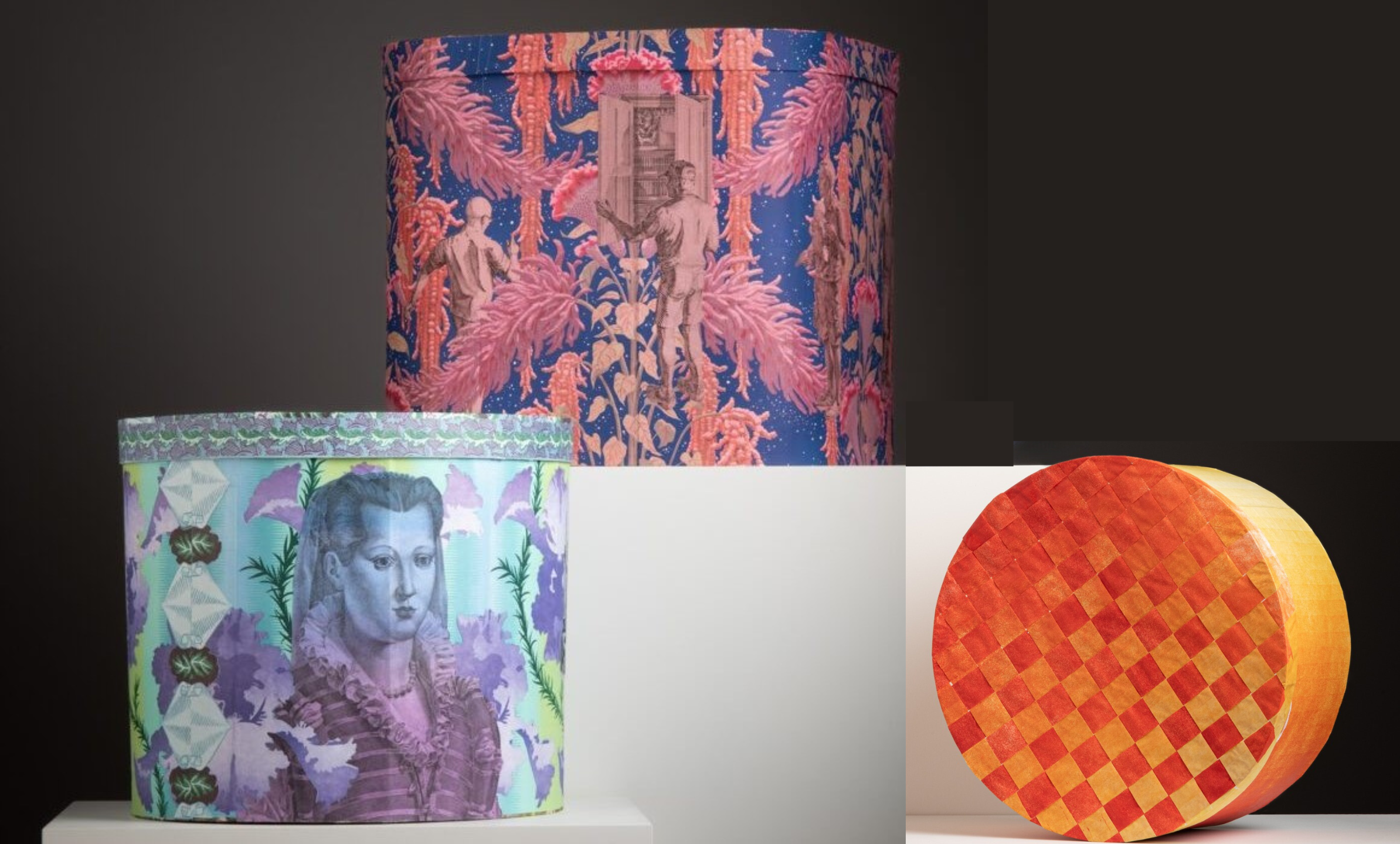
Lead photo: Bandboxes by Andrew Rafferty. Photos via Winterthur.
Winterthur Museum, Garden & Library in Wilmington has a new exhibit that draws inspiration from history, nature and the museum itself. More than 30 artists and makers from around the country created pieces for Transformations: Contemporary Artists at Winterthur. From fabric arts to furniture, painting to serving pieces, bandboxes to landscaping, Transformations explores people, history, and influence and reimagines the varied collections of Winterthur.
At its core, Transformations merges contemporary art with Winterthur’s past. It is a monumental task that museums around the world are grappling with, including many in the Brandywine Valley. Winterthur’s take on that challenge is one of the most groundbreaking. In unexpected ways, Transformations features exhibits which draw on Winterthur’s collections, conservation experience, and history.

“The Maker-Creator Fellowship Program was the seed of inspiration for this exhibit,” said exhibition curator Catharine Dann Roeber, Winterthur’s director of Academic Affairs, the Brock W. Jobe Associate Professor of Decorative Arts and Material Culture, director of Winterthur’s Research Fellowship Program, and executive editor of Winterthur Portfolio. This annual program, which has offered researcher fellowships since 2009, invites over two dozen artistic and creative professionals to explore Winterthur’s collections and use the inspiration to create new work.
Transformations is almost like “a dollhouse on a large scale, creatively reimagining objects,” Roeber said. The artworks are displayed in tableaus that explore every dimension of the galleries, with careful consideration for lighting, color, and even sound. There is a “focus on the artists themselves, and how they want to be represented,” said Roeber.

In its own way, Winterthur is a piece of art, a carefully curated home which has evolved into a walkable, experiential medium. The scrapbook table from the Winterthur collection – displayed in the opening room in a clever dicenium which transforms into a graphic showing the names of all the participating artists – is a fantastic example. The table was made by a young girl in the 19th century. “Even though many of these people are professional artists and makers, real people now and in the past are makers too,” Roeber said.
Farther into the exhibit, a gorgeous tricenium — an artwork which appears to be three different scenes depending on the angle from which it is seen — from Philadelphia-based artist Rebecca Gilbert explores beauty, love, and loss. “The work invites viewers to explore optics, perception, and the act of seeing by transforming intricately detailed prints into dimensional works on paper,” wrote Gilbert in her artist statement.


The ways in which the collections inspired artworks are as varied as the artists themselves. Sculptor Joey Quiñones combined fiber and ceramics to create a scene which challenges traditional narratives. “The collection of decorative objects tells us as a society who and what we value, and who and what we don’t,” they wrote in their artist statement. “I created items that would have never existed in the early founding of the U.S. and the Americas (Caribbean included) but more accurately depict the racial and gender dynamics of the period. It influences us still today. With this exhibit, I aim to inspire a dialogue on race, colonization, and the transatlantic slave trade.”

Like all exhibitions, the juxtaposition of artworks in the galleries creates interesting dialogues for viewers. But there also were surprises for the artists as they explored the collections and interacted with other Maker-Creator Fellows. Elaine K. Ng, an artist who utilizes material investigation and process-based practices from the past, came to research the cultural significance of plants in the Winterthur Gardens and their use in fabric creation.


“Through a serendipitous encounter with economic historian Alka Raman (also a Winterthur Fellow), a 1966 translation of 18th-century French manuscripts from the library, and an 18th-century Indian palampore on exhibit from the museum collection, my fellowship evolved into a collaborative exploration of traditional chintz techniques and the links between material knowledge, culture, and place,” said Ng.

Multiple artists used the power of collaboration to create their pieces. Kate Sekules, a mending advocate, activist, educator, and researcher, used socks creatively darned by the “Socksisters,” fabric artists around the world, to overhang her powerful visibly mended artwork. The Bandbox Collective presents bandboxes—structural containers used as hatboxes and other packaging—from the Winterthur Collection and new creations in many shapes with elements of painting, millinery, origami, printmaking, wallpapering, and even “diamond painting.”

Perhaps the most unexpected work is one which will continue for decades. “The Radish Project” is a collaboration from artist Dan Feinberg and soil scientist Dr. Mary Parr which plants tillage radishes in asphalt, using patterns inspired by the parquet floor of the Empire Parlor, as well as other designs. The exhibition invites visitors to watch how the plants grow, rot, and break pavement to create better drainage and soil for future generations in a multimedia display that continues in the museum itself.
As Roeber said, “There is tradition and joy in the making.” This exhibition explores how that has been utilized in the past to create the objects in the collection, and how it can be celebrated as well as reconciled with new understanding by artists, creators, and makers of all backgrounds.
Transformations: Contemporary Artists at Winterthur is on view through January 5, 2025. Daily guided gallery walks of Transformations are free with admission. No reservations are required. Walks begin in the Galleries Reception Area daily at 2 pm. Winterthur is located at 5105 Kennett Pike, Wilmington, DE. For hours and tickets, click here.
Connect with Main Line Tonight!
Join the in crowd! Get Main Line Tonight’s stories delivered to your inbox.


That’s Amore: Il Fiore In Bryn Mawr